How to break big projects into smaller parts
Last week, I wrote about the importance of stacking bricks as a strategy for getting shit done with ADHD.
In it, I noted…
But our brains also have limited RAM. If we start thinking about the details, we can often get lost in them, freeze, and get nothing done.
Today, I wanted to talk about what to do when that happens. Let’s dig in!
Making big tasks into little tasks
A week ago, I commented that each day I either work on…
- One or two big tasks and a few smaller tasks
- Up to a dozen smaller tasks
Sometimes, the big task is so exciting that I just dive right into working on it. I’m excited, and I can’t wait to start.
But sometimes, it feels completely daunting. When that happens, I need to break it up into smaller, more manageable parts.
Plan on paper
As much as I love digital tools for managing my ADHD, paper is the absolute champ when it comes to thinking through big problems.
Paper let’s me thinking in a non-linear way.
I don’t have to go left-to-right, top-to-bottom. I can start in the middle. I can scribble in the margins. I can work in a circle.
I don’t have to fight the software.
If I want to add icons, connect things with arrows, or represent an idea as a chart or sketch, I don’t have to figure out how to do that in the software or find a tool that can do it.
I just put my pen on the paper and write.
But how exactly do I do the planning? Let’s look at a practical example…
An example: Split the Check
Let’s imagine I need to write an app that tells you how much each person in your party owes for a meal.
To figure this out, You would need a few pieces of info from the user:
- The cost of the meal
- The amount you want to add as a tip
- The number of people in the party
The first thing I would do is sketch out those fields. I’m a visual person, and seeing them helps keep me focused on what I’m trying to accomplish.
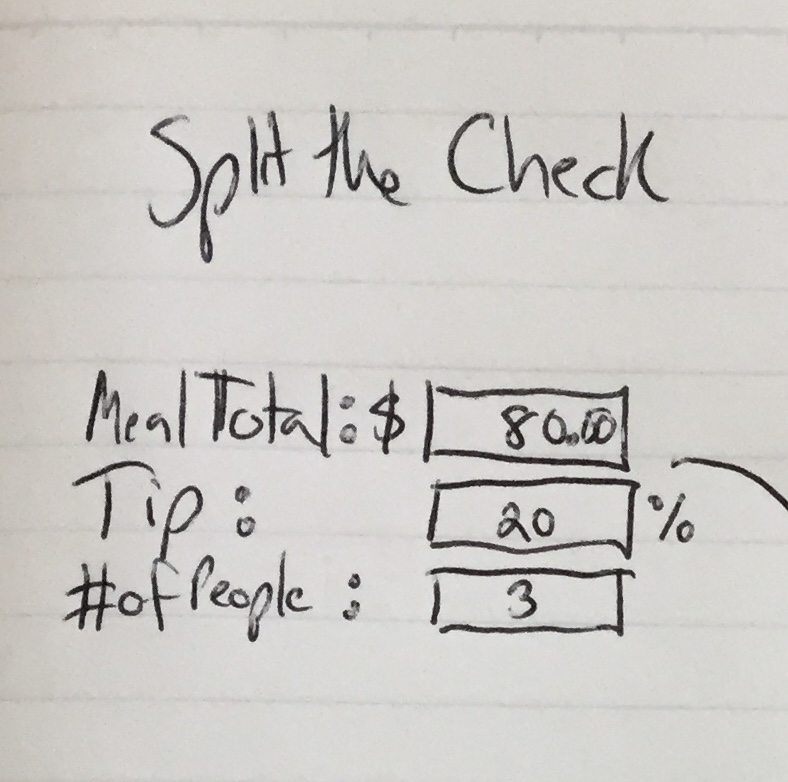
Next, let’s think through what the script would need to do to actually calculate the per-person amount.
- Convert the tip as a percentage into the tip as a decimal so that we can use it in our math.
- Get the tip amount (in dollars) for the meal.
- Figure out the total cost of the meal including tip.
- Divide that total by the number of people.
Now, we can actually map out tactically what our script would need to do to complete those tasks. To help me out here, I would go so far as to write actual amounts into my sketch to have real numbers to work with.
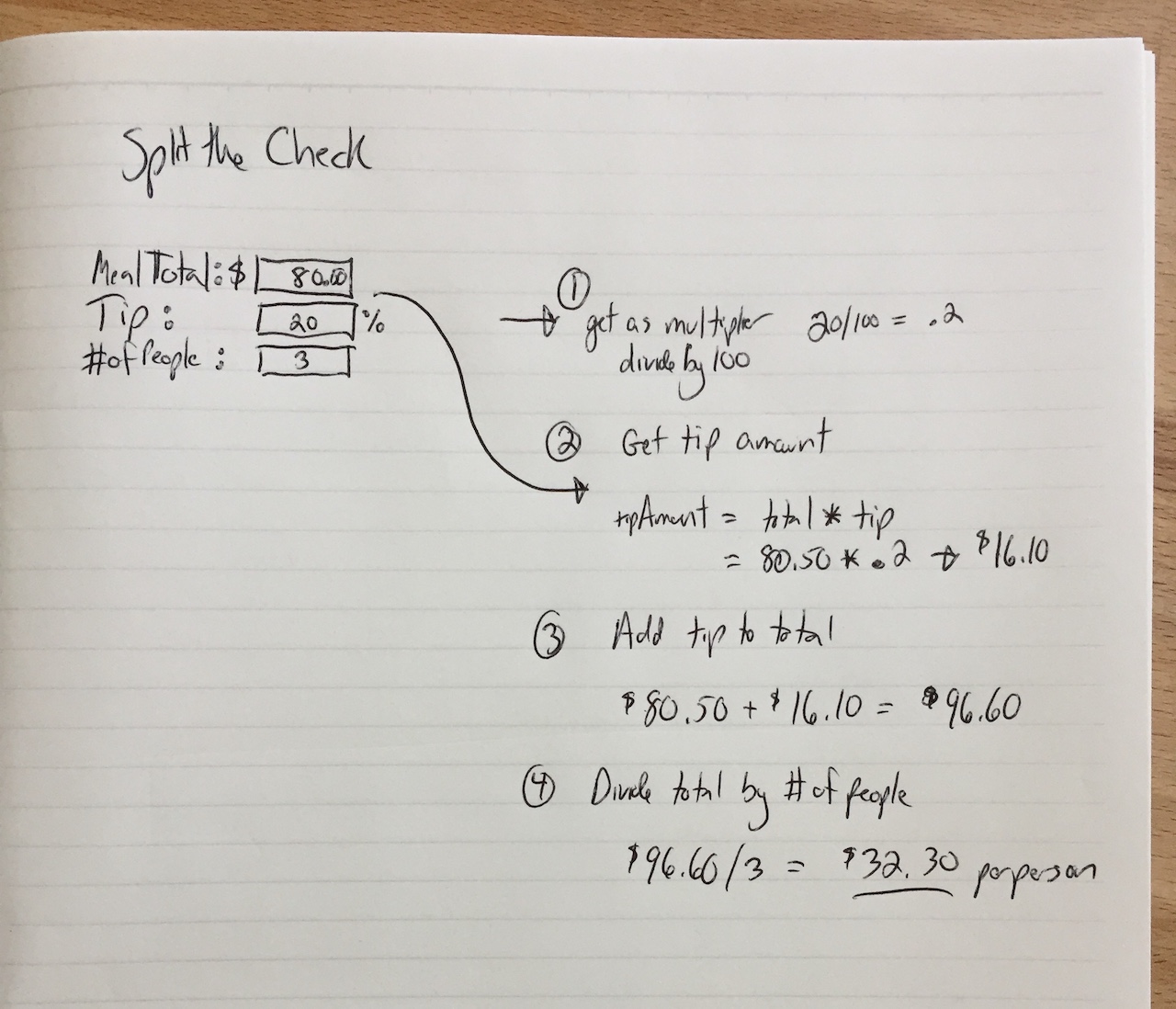
Convert the tip as a percentage into the tip as a decimal so that we can use it in our math.
20/100 = .2Get the tip amount (in dollars) for the meal.
$80.50 * .2 = $16.10Figure out the total cost of the meal including tip.
$80.50 + $16.10 = $96.50Divide that total by the number of people.
$96.60 / 3 = $32.30 per person
And now, based on all of that, I have a list of smaller task I need to complete to build the app.
Adding items to your second brain
For a smaller app like this, I might be able to complete all of these steps in a single day. In that case, I’d just start working through them.
On a bigger app, I’d end up with a laundry list of tasks.
In most cases, I’d copy them into my second brain as a list of subtasks. Those then become the things I add my todo list each day instead of the one big task.